




.jpg?width=300&name=Frame%204728%20(1).jpg)

We provide a detailed introduction to the process of personalizing your site, including ready-made strategies to implement, challenges you need to consider, and examples to get you started.
Table of Contents
- What is website personalization?
- Key advantages of website personalization
- Typical challenges in the website personalization process
- Website personalization - a brief essential
- Types of data used in website personalization
- Types of page personalization
- Examples of page personalization
- Page optimization vs. SEO
- A simple website personalization strategy
The world used to be simpler - in order to attract users, companies entering the e-commerce market only needed a good-looking website, regular content publishing and wise investments in SEO and paid media, as well as emailing once a week. As the digital world evolved, the rising Customer Acquisition Cost (CAC) led to A/B testing to generate a steady flow of customers by optimizing various elements of the website.
However, in a space with nearly 2 billion user pages and an ever-growing number of online channels, testing alone may not be enough. In some markets, there have been as many new online stores in the last 2 years alone as there have been in the last 6 years. Today's brands that want to influence the consumer's decision-making process will have to invest in personalizing the site and reaching out to the consumer on a highly individualized level.
Read also: How to use Agile to manage an effective personalization and optimization team?
What is website personalization?
Personalization was once merely a tactic, commonly associated with combining CRM (Customer Relationship Management) data with ESP (Emotional Selling Proposition) to personalize content by customer name. Today it is a full-fledged marketing discipline, encompassing channel management, strategies and having a well-described implementation process.
Indeed, marketers are less and less interested in meeting the needs of the "average user" with simple segmentation. Instead, they prefer to proactively respond to the unique needs of the customer to increase the effectiveness of their marketing communications and market share.
Key advantages of website personalization
Today's consumers place a high value on a personalized approach and are more likely to choose companies that personalize their experience.
Users are diverse, and each has their own interests, desires and motivations. Therefore, delivering a non-personalized website experience, or even one created for a specific audience, is not the most effective way to generate actions and conversions.
Typical challenges in site personalization
Personalization is not an easy process - not least because, despite appearances to the contrary, it is quite a complicated field. You can personalize virtually anything, just like in a game of chess, where the openings and variations in the game alone are more than 1,327.
It is important to remember that with the proliferation of new technologies, it has undergone a lot of evolution. Challenges that plagued specialists just a few years ago can now be effectively addressed:
- Data stored in several tools can now be transformed into a single customer view.
- Template mechanisms and improved campaign design workflows that will take extra work off key specialists.
- Thanks to modern tools that often offer ready-made tactics to get started, choosing effective personalization efforts has become much easier and accessible to virtually anyone.

Zobacz, jak pomogliśmy innym biznesom
Na swoim koncie mamy wdrożenia w takich firmach jak Orange, T-mobile czy Homla. Sprawdź nasze case study i zobacz jak dzięki automatyzacji marketingu udało nam się zwiększyć zyski i lojalność ich klientów.

Website personalization - a brief essential.
A personalized approach to marketing involves several elements that require brands to combine, consolidate, analyze and activate data. This is only possible if the following technological factors are present in the so-called personalization engine:
A unified data set
In order to create a consistent dataset based on important events and activities, it is necessary to efficiently extract information from multiple sources. Therefore, consider replacing several separate marketing solutions with a holistic solution that is a multi-channel personalization platform that allows information to flow freely between systems, as well as within the organization.
Open architecture
Remember that integrating your engine with your marketing tools will only enable you to successfully implement personalization if it runs seamlessly. High flexibility can reduce design time and generate new opportunities by shortening process execution.
Decision engine
To increase efficiency, scale operations and provide each customer with an optimal experience, automating decision engines and delivering real-time insights is essential. As the number of tests, variations and segments collected as part of the personalization process increases, evaluating the impact of this data on the user becomes an extremely challenging task. With help comes Machine Learning to help you predict certain behaviors, preferences, next actions or lack thereof. The days when we had to make decisions on our own are coming to an end. You don't have to make all decisions on your own. Artificial intelligence algorithms can support you in this. .
Choosing the right personalization solution is therefore crucial, as it ensures not only cost-effective spending, but also generating results in a sustainable, scalable way and less stress at work.
See also our post: How to identify and reach your brand's most valuable customers?
Types of data used in site personalization
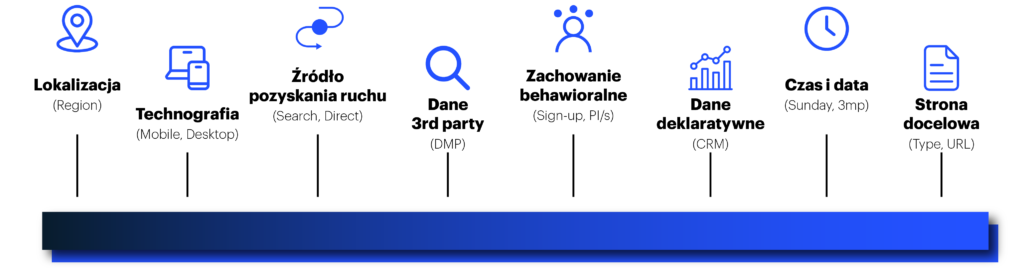
User targeting should be done using a proven and unified data source. To provide the right experience to the right user at the right time, a brand can combine its sources and use a lot of disparate information in real time. However, the more criteria used, the more likely it is that a given user will not meet the targeting conditions of a personalized campaign or the segment will be too small. Each of us is looking for optimal solutions, but we are also looking for solutions that will give us the right scale
| Target group criteria | Description |
| Location | The country, region or city where the user resides. |
| Technology | Type of user's device (desktop, smartphone, tablet), operating system, browser and even screen settings. |
| Sources of traffic acquisition | The specific traffic source from which the user was acquired - organic or paid, referral or from social media. |
| Third party data (3rd party data) | User information collected from third-party sources and grouped by a DMP (Data Management Platform). |
| Behavioralbehavior | Key user actions, such as clicks, add to cart or purchase, as well as page views, URLs visited, etc. |
| Explicit data - Declarativedata | Data collected via CRM or surveys and registration forms. |
| Time and date | The selected time range over which the experience will be available to the user. |
| Destination page | The type of sub-page a user goes to - a specific URL, homepage, "product description" (PDP), or shopping cart. |
Although third-party data typically accounts for the largest percentage of site traffic (~75%), personalization based on it will be the least accurate. Especially now with the introduction of a new type of event tracking on Apple-branded devices, for example. User tracking accounts for the second largest share of traffic (~60%) and has average accuracy, but is useful in understanding overall traffic patterns.
Both user behavior captured by algorithms (~30%) and CRM data (~15%) are considered the most accurate, and used properly, will result in fantastic user experiences.

Types of website personalization
Website personalization comes in many different forms, and each is designed to achieve a different goal. The following experiences can be freely tested, optimized and personalized for each visitor, and together they are great tools for improving the entire funnel.
| Experience type | Use Case |
| Dynamic content | Replace default banners, CTA buttons, promotional modules or any other element on the page with dynamically generated content variations. |
| Suggestions | Display content or products according to attributes in the data source, visitor interactions and trends in visitor behavior. |
| Dynamic banners and pop-ups | Highlight a selected offer with a large, visible pop-up. |
| Notifications and widgets | Add an unobtrusive element in the corner of the screen or as a drop-down bar or window. |
| Messages | Customize CTA copy, promotional text or social proof throughout the site. |
| Landing page | Personalize content variations for each user instead of using default text. |
| Personalize menus | Reorganize or reorder the navigation bar based on each user's preferences. |
| Search personalization | Generate results according to visitor preferences and real-time behavior. |
Today, the customer journey is no longer linear and spans multiple touchpoints, so brands have even more opportunities to provide tailored experiences, whether users are online, opening a newsletter or launching a mobile app.
Examples of website personalization
There are several proven ways to use so-called 1st party data to better personalize content, such as
- Providing personalized content and recommendations on the homepage based on the user's relationship with the brand.
- Using loyalty program data to more accurately personalize the experience.
- Designing personalized landing pages based on user behavior.
There are hundreds of examples of personalization that have successfully increased conversion rate, Average Order Value, margin or conversion itself. The benefits of this process are undeniable.
According to a McKinsey report, properly personalized experiences lead to a reduction in acquisition costs of up to 50%, an increase in revenue of 5-15% and an increase in the efficiency of marketing spending of up to 30%.
Site optimization vs. SEO
Experts have concerns that dynamic content can negatively affect SEO rankings. Despite the fact that Google approves the use of dynamic site personalization to improve CX, there are technically four main risks to consider during personalization efforts.
- Hiding content presented to the Google robot
- Using inappropriate redirects
- Duplicate content and URLs
- Page loading speed
A simple website personalization strategy
There are some practical tips you can follow to maximize the results of your personalization efforts, not only from the beginning of the process, but also as you scale.
You don't need all the data in the world - Many companies have the misconception that a lot of data is needed for thoughtful personalization. And indeed, the more extensive the collection you have, the better you understand your audience. However, you can use even simple, readily available behavioral data on your website and marketing communication channels to improve your users' experience, which is worth collecting and segmenting. So don't fall into the trap of collecting all available information. Instead, start using what you have at hand right now.
Don't kidnap yourself with a hoe in the sun - Personalization is a marathon, not a 100-meter race. Your company should start with simple tests and experiment with smaller elements of the digital experience, such as banners on the homepage, images next to product descriptions, CTAs, recommendation frames, titles in marketing messages, etc.
Focus on audience data - Once you've run enough tests, you can start analyzing the data you've collected for key relationships between groups, such as behavioral behaviors, historical purchase data, common traffic sources or certain demographic/psychographic attributes. Users, in return, will receive experiences created from important events, activities and behaviors that are relevant to their perspective, for which they are sure to appreciate you
you in the future and will be eager to make repeat purchases/sign new contracts.
AI helps with automation - If you use algorithms that collect all user data and signals, you can deliver your best CX to each user automatically, no matter where they come from, what device they use, etc. AI can both speed up the whole process and make it more accurate.
Your actions must change with your target audience - Users change their habits and behaviors. That's why you need to take a long-term approach - continuous optimization and personalization of your site is key to maximizing results.
Welcome to the new generation of digital marketing
The success of any e-commerce business today depends on its ability to recognize, understand and replicate the needs, desires and preferences of its current and potential customers. With help comes the personalization of content and communications, which has earned a well-deserved permanent place among the tools of every innovative business.